





The weekend is here! Pour yourself a mug of Danish Blend coffee, grab a seat outside, and get ready for our longer-form weekend reads:
• Once a Gamble in the Desert, Electric Grid Batteries Are Everywhere: An early grid battery was installed in the Atacama Desert in Chile 15 years ago. Now, as prices have tumbled, they are increasingly being used around the world. (New York Times)
• Why We Can’t Quit Excel. Microsoft’s spreadsheet software is expensive, derivative and depressing. It might also be the most killer app of all time. (Bloomberg)
• The New Private-Equity Billionaires Who Are Taking Over Wall Street: Private-market institutions are taking over from old-line legacy banks. The names to watch—and the dangers to watch out for. (Barron’s)
• Local Spies with Lethal Gear: How Israel and Ukraine Reinvented Covert Action A potent new fusion of old-style human spycraft with cutting-edge technology is having a big impact on high-stakes conflicts. (Wall Street Journal)
• Very Important People: “Whichever line is the longest,” I said. “That’s the line I belong in.” (Dirt)
• This is the future of war: Human history can be told as a series of advances in warfare, from chariots to crossbows to nuclear-tipped missiles, and we are living through what may be the fastest advancement in weaponry ever. Ask any five veteran national security experts and you will hear about five different emerging technologies with the potential to change the world of combat. Swarms of robotic aircraft that work in unison to find and kill targets without any human oversight. Advanced cyberweapons that can immobilize armed forces and shut down electrical grids across the country. A.I.-designed bioweapons engineered to kill only those with certain genetic characteristics. (New York Times)
• The Decline of Deviance Where has all the weirdness gone? People are less weird than they used to be. That might sound odd, but data from every sector of society is pointing strongly in the same direction: we’re in a recession of mischief, a crisis of conventionality, and an epidemic of the mundane. Deviance is on the decline. (Experimental History)
• How a Cryptocurrency Helps Criminals Launder Money and Evade Sanctions: Through layers of intermediaries, stablecoins can be moved, swapped and mixed into pools of other funds in ways that are difficult to trace, experts say. (New York Times)
• Borderlands: The Baltic countries are fortifying their frontier regions as a deterrent to Russian aggression. Close to the border, communities now have to reckon with the price of peace. Estonia and its fellow Baltic countries, Latvia and Lithuania, lie on the eastern flank of NATO and the European Union, facing across more than 1,000 kilometers (621 miles) of border towards a hostile Russia and its ally, Belarus. They’re members of the most powerful military bloc in the world, but with Donald Trump in the White House that alliance looks uncertain. (Bloomberg)
• Harder work than almost any album we ever did’: Pink Floyd’s Wish You Were Here turns 50 As the classic album hits 50, Nick Mason talks about the often difficult process of making it and how it has since fit into their larger catalogue. (The Guardian)
Be sure to check out our Masters in Business interview this weekend with Stephen Cohen, BlackRock Chief Product Officer and Head of Global Product Solutions. He is a member of BlackRock’s Global Executive Committee. Previously, he was Global Head of Fixed Income Indexing (iShares); and Chief Investment Strategist for International Fixed Income and iShares. Blackrock manages $13.5 trillion in AUM; its iShares division is over $5 trillion.
Is China winning the innovation race?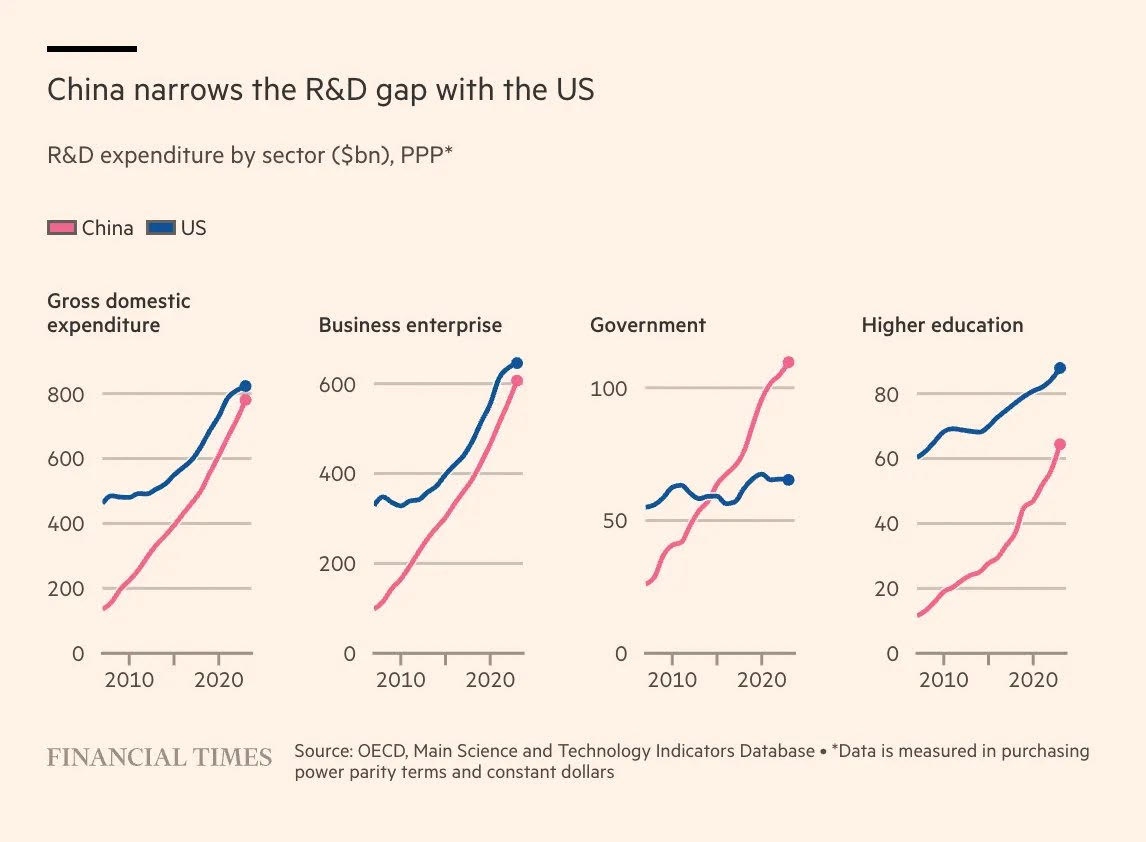
Source: Financial Times
Sign up for our reads-only mailing list here.
~~~
To learn how these reads are assembled each day, please see this.